Blue Sheet > Australia> Commonwealth Coinage> One Penny> George V > 1930 Penny

1930 Penny


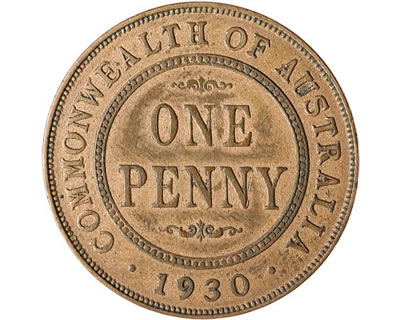
The 1930 penny is the most famous Australian coin and one of the world's most valuable circulating copper coins. Its fame originates from the 1940s and 1950s where its rarity was first revealed to the general public, thus creating a surge in interest with the general public searching for this key rarity in their change. Consequently the average 1930 penny only circulated for 15-20 years leaving the average grade at around the Fine to VF level, slightly higher than pennies from surrounding years.

This interest has lasted on giving it the title of Australia's Glamor coin, and the key date to every penny collector's set. Consequently, despite a relatively high estimated mintage of 2000-3000 pieces, the 1930 penny commands prices similar to much rarer coins such as pre-decimal proofs.

In 1930, with the economy slowing to a halt, the treasury did not request any pennies to be struck, as with denominations from threepence to florin, there simply wasn't any need for additional currency with the great depression in full force. Despite this, a small number of 1930 penny dies were prepared (Coin Web, 2007) and it is suggested that visiting dignitaries were permitted to purchase fresh pennies, dated 1930 from the mint (Coin Web, 2007). This would seem to contradict the minimal number of upper grade examples of the date, with no known examples in mint state. It is more likely that the coins were struck to test the dies as suggested by Andrew Crellin (Sterling & Currency, 2008).

The coin itself is fairly scarce in lower grades with about 1500 pieces in the market today, above XF the coin becomes very rare and is almost unheard of in AU grades. The coin usually features a central strike weakness on the reverse and is paired with an Indian obverse die.

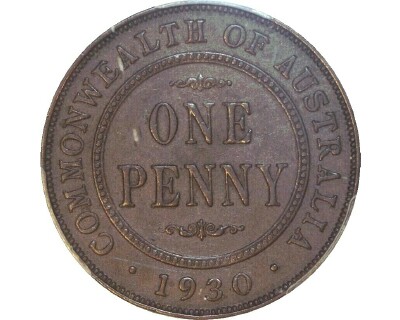
At the end of 1930, the Melbourne mint also produced proof strikes for various museums and as proof of record pieces for the mint (Learn more about the 1930 Proof Penny).

Do you have one of these to sell? Sell it on Numis Bid
 
Contents
Mintage
Est. 3,000
Reverse Designer
W. H. J. Blakemore
Obverse Designer
Sir E. B. MacKennel
Size
30.8 mm
Composition
97.00% Copper
2.50% Zinc
0.50% Tin
Bullion Value
1930 George V Penny
Reverse

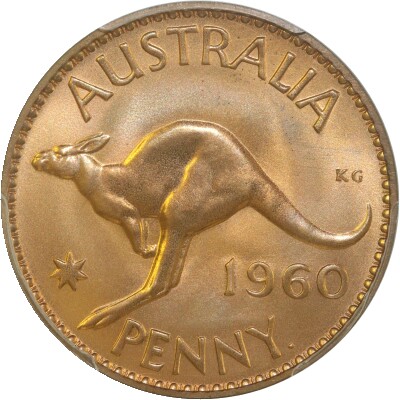
1930 George V Penny
Obverse

Valuation
Typical Handled: $17.5K  
This valuation represents a typical handled example of the coin. Coins in better condition will command a substantial premium over the listed price. For example, an average 1911 florin is worth around $50, but in choice uncirculated condition is worth about $15,000! To view valuations in higher grades, please click here to subscribe.  

Glossary
  • central strike weakness - A weak strike around the centre of the design caused by a lack of concavity in the dies relative to strike pressure.
  • die - A cylindrical punch with an inverted impression of a coin's design used to strike the coin
  • key date - A difficult date to acquire in any grade, hence being the key to a series
  • mint - a facility that produces coins
  • mint state - A state of a coin that shows no signs of circulation
  • mintage - The number of coins struck of a particular designation
  • obverse - The heads side of the coin
  • pre-decimal - Denominations without base 10 equivalents
  • proof - A coin struck from specially prepared dies to strike a superior quality coin not intended for circulation
  • proof of record - A proof or specimen strike intended to represent a circulation piece produced for mint records
  • reverse - The tails side of the coin

Numismatic Glossary - View the full glossary of numismatic terms.

References

References - View full bibliography

Links

Index